

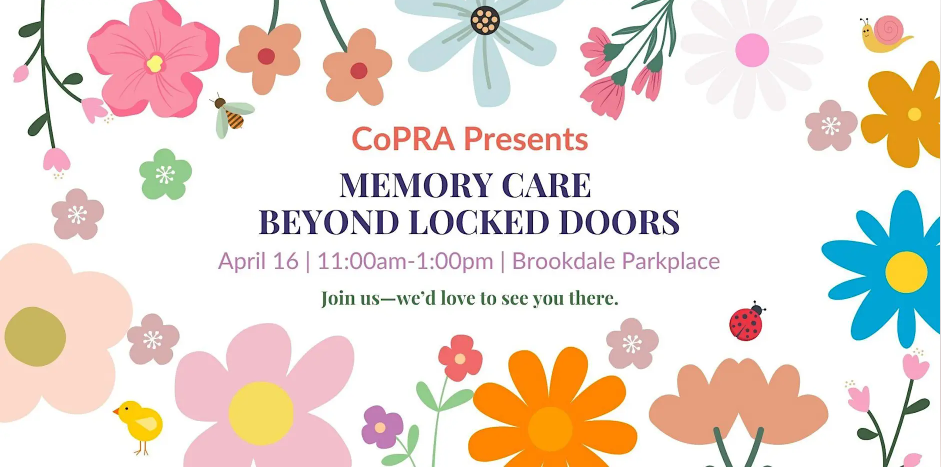
We had the pleasure of attending a meeting of the Colorado Placement and Referral Alliance (CoPRA) this week and took part in a discussion entitled, ‘Memory Care Beyond Locked Doors’. Some interesting ideas were shared, rethinking the need to house every person with dementia inside a locked building. Here is a summary of some of the ideas presented.
People with dementia, while needing support to live as close to normal lives as possible, still have rights and freedoms, including the right to be free from unnecessary constraints when appropriate. Is it appropriate to contain all people with dementia within locked doors at all times? Clearly, some people can pose a danger to themselves by wandering off, but there are other ways of handling this situation with residents for whom this is not the case.
What is sometimes seen as a ‘behavior’ in a person with dementia can alternatively be considered a sign of an unmet need. We can ask ourselves, ‘What is the unmet need being expressed by this person?’ This person has had a long life full of purpose and responsibility, often leaving their home every day to go to a place of work. Could it be that they are seeking those intangible things that once gave meaning to their life when they try to leave the building?
The word ‘purpose’ can be defined as a feeling of contributing to one’s community. If a person is seeking purpose by trying to leave, and we can provide that purpose to them in the place where they live, this can be as much a safety feature as the locked door. When they find purpose in their home, they may be less likely to go seeking it elsewhere. Purpose can be provided simply by giving the person a task that makes them feel that they are contributing to the community — helping to set the table, accompanying caregivers on rounds, counting to make sure all the other residents are accounted for, cleaning up after activities.
Another approach is to support their wish to roam by providing support instead of limiting their movement. While it might not always be practical or convenient to accompany someone, it is compassionate and supportive, when possible, to just walk along with someone who has a desire to go out. It doesn’t have to take long and often times the person will soon decide they want to be back in their normal surroundings, or can be redirected to return, rather than barred from leaving. The short amount of time spent supporting the person in this way can pay off handsomely in terms of the person feeling respected, dignified, and less agitated.
CareBuilders at Home appreciated the opportunity to attend this lively and engaging event, organized by CoPRA. We applaud the efforts of senior living communities that seek to meet their residents’ momentary needs in creative ways, and provide a purpose-driven life for them as a way of keeping them safe while maintaining their dignity.